Why NRI Plots are Easy Targets
For Non-Resident Indians (NRIs), owning land in rapidly developing cities like Hyderabad is both a lucrative investment and an emotional anchor to their homeland. However, this distance creates a vulnerability gap that land grabbers expertly exploit.
The Psychology of Encroachment
Encroachment isn't always a sudden, violent act. Often, it is a slow, psychological game. Local land sharks or unscrupulous neighbors operate on the assumption of absence. They know you live thousands of miles away. They calculate that the cost of your travel to fight a legal battle is likely higher than the value of the land they are stealing (or the settlement they will extort from you).
It starts small—a temporary shed for "storage," a pile of construction debris, or a slight shift of a fencing stone. Note that the people living in sheds are often connected to local land sharks. If you don't react within a few months, they assume the property is abandoned or unmonitored. This silence is their green light to proceed with forged documents or permanent structures.
Essential Safeguards for NRIs
Relying on a distinct cousin or a significantly older uncle to check your property is not a strategy; it's a favor that eventually runs out. To truly protect your asset, you need professional and legal safeguards:
- Professional Monitoring: You need an unbiased set of eyes. A professional service provides time-stamped, geo-tagged evidence of your property's condition. Unlike relatives, they don't have "social obligations" to the encroachers (who might be powerful locals).
- Legal Representation vs. Power of Attorney (PoA): Many NRIs indiscriminately give General Power of Attorney (GPA) to relatives. This is risky. A GPA allows them to sell the land. Instead, consider appointing a Legal Representative or a Limited PoA specifically for maintenance and legal disputes, retaining the selling rights for yourself.
- Public Caution Notices: If you suspect foul play, issuing a "Public Notice" in local newspapers (both English and Telugu) declaring your ownership and warning against fraudulent transactions is a powerful deterrent. It creates a public record that you are an active, vigilant owner.
- Digital Footprint: Ensure your property is mutated in your name in the Dharani portal (for Telangana) or relevant state digital records. A physical deed is good; a digital record is better.
Immediate Action Plan
If our monitoring detects an issue, do not panic and rush to book a flight immediately.
- Gather Evidence: We provide you with the on-ground photos proving the timeline of the encroachment.
- File a Complaint: You can file a complaint with the local police station (often possible online) or through a legal representative filing a civil suit for "Permanent Injunction."
- Secure the Perimeter: Once the legal initial step is taken, immediately reinforce the boundary. Fences make good neighbors; walls make better protectors.
SafePlots acts as your operational arm on the ground, handling the monitoring and evidence gathering so your legal team has everything they need to win.
Understanding Vacant Land Tax (VLT)
Vacant property is often viewed as a "dead asset" that only appreciates in capital value. However, the government requires it to contribute to civic revenue. The Vacant Land Tax (VLT) is a mandatory levy by the Greater Hyderabad Municipal Corporation (GHMC) on any plot that does not have a constructed building.
Is Your Plot Covered?
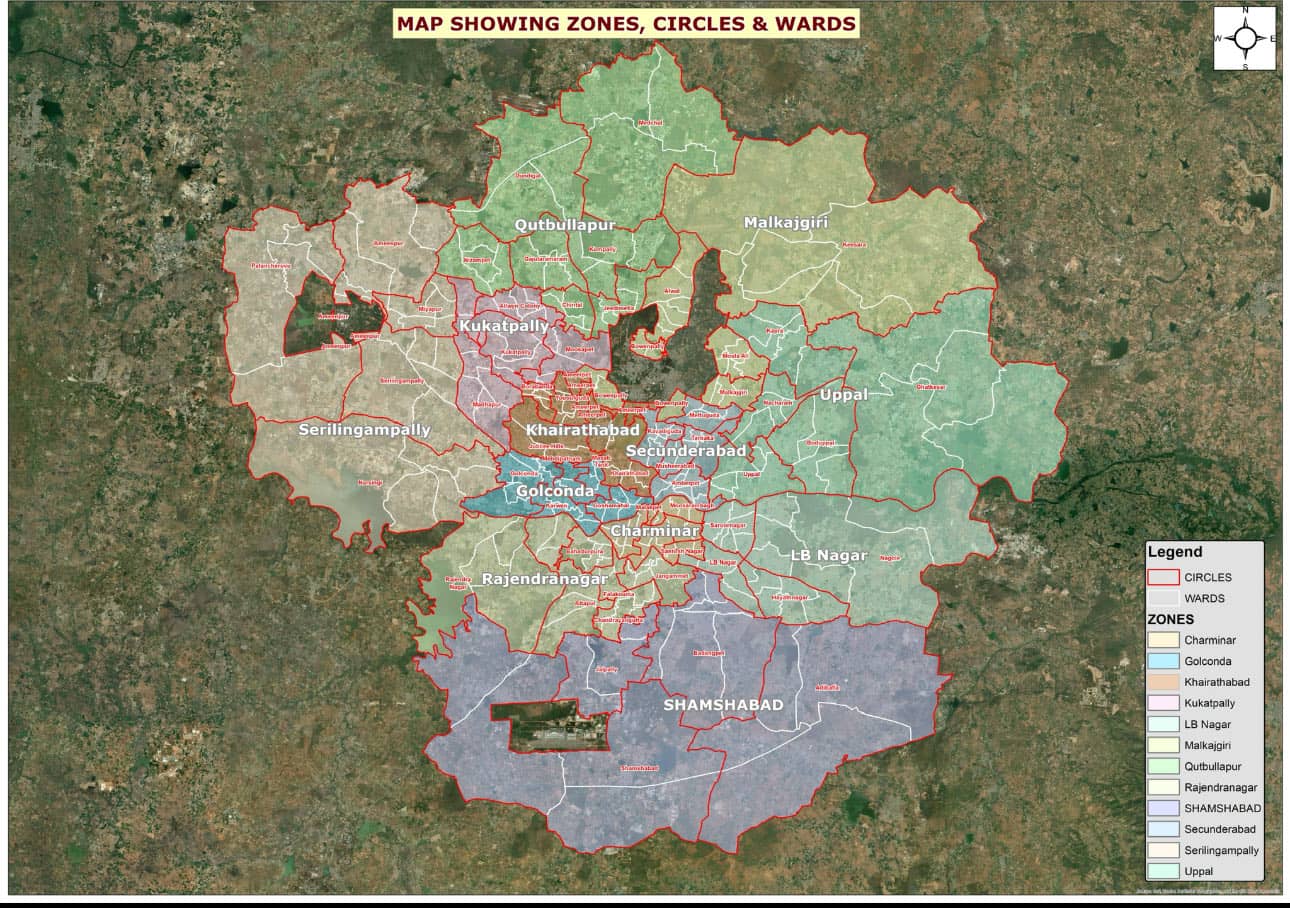
Below map is the new GHMC map which includes the recent expansion of municipal limits, many areas previously considered "gram panchayat" are now under GHMC jurisdiction for tax purposes.
If your plot falls within these colored zones, you are liable to pay VLT regardless of whether it is in a gated community or an open layout. Note that this is good for you. I will explain below.
"You Might Not Need a Room"
For decades, a common piece of advice given to plot owners was: "Build a small watchman room and get an electricity meter. It proves you are in possession."
Sure but constructing a room costs anywhere from ₹2 Lakhs to ₹5 Lakhs. Getting an electricity connection often involves bribes.
Instead of wasting lakhs on a room that will eventually crumble, fencing the plot and paying your VLT is a far smarter legal strategy.
A government tax receipt, paid every 6 months in your name, is a gold-standard document in court.
It creates an undeniable digital paper trail.
What's more, fencing is cheaper by 70% compared to room & also increases the plot value. So the cost of fencing can be recouped when you sell the plot.
The Calculation & Consequences
In Hyderabad, VLT is generally calculated as 0.5% of the capital value of the land.
Example Calculation:
Plot Size: 200 Sq Yards
Registration Value: ₹10,000 per Sq Yard
Total Value: ₹20,00,000
Annual VLT = 0.5% of ₹20,00,000 = ₹10,000 / year
Compared to the risk of losing your property, this is a small insurance premium. Ignoring it invites the Revenue Recovery Act, where the government can attach your property to recover dues, often with a punishing interest rate of 24% per annum.
Precast Walls vs Fencing
When you buy a plot, your first instinct is to mark your territory. For years, the standard approach was "Stone Pillars and Barbed Wire." While cheap, this method is increasingly becoming a liability rather than an asset.
The Hidden Liabilities of Open Plots
An open plot with weak fencing isn't just a risk for encroachment; it's a legal liability.
- The 'Debris' Magnet: In growing colonies, if one person throws construction debris on your plot and gets away with it, within weeks, the entire neighborhood will treat your land as a dump yard. Clearing truckloads of debris can cost you tens of thousands of rupees before you can even start construction.
- Illegal Activities: Secluded plots often become hotspots for anti-social activities—drinking, gambling, or drug use at night. If a crime occurs on your property, you, as the owner, will be dragged into the police investigation.
- Accident Liability: If you have an open well or a construction pit, and a child or animal falls in because your barbed wire was cut, you are criminally liable for negligence.
Why Precast Walls Win
Precast compound walls have revolutionized plot protection. Unlike brick walls which require water curing, labor monitoring, and weeks of time, precast walls are installed in days.
Technical Superiority:
- Deep Foundation: The columns are planted 1.5-2 feet deep into the ground with concrete. They cannot be simply "pushed over" like stone pillars.
- Interlocking Strength: The panels slide into grooves in the columns, creating a solid barrier that blocks view. If people can't see inside, they are less likely to dump trash or enter.
- Reusability: If you decide to construct a building later, these walls can be dismantled and moved (or sold), unlike brick walls which must be demolished.
The initial cost is higher than wire fencing, but the Return on Investment (ROI)—in terms of peace of mind, legal safety, and property value—is significantly higher. A walled plot always commands a premium price over an open one.
Satellite Monitoring Explained
At SafePlots, we don't just "Zoom In" on Google Earth. Google Earth imagery can be months or even years old. We task dedicated earth observation satellites to capture fresh data of your property. Specifically, we rely on the Sentinel-2 constellation, utilizing Level-2A (L2A) data products.
The Science: L1C vs. L2A Data
Most free satellite imagery is "Top-Of-Atmosphere" (Level-1C). This means the camera sees the ground plus all the dust, haze, and water vapor in the air. It often looks washed out or cloudy.
We use Level-2A Bottom-Of-Atmosphere (BOA) data. This data has undergone complex "Atmospheric Correction." Algorithms strip away the atmospheric noise to reveal the true surface reflectance of your land. This is critical for automated monitoring because it ensures that a "change" detected by our AI is actually a change on the ground, not just a hazy day.
Beyond the Visible Spectrum
Human eyes only see Red, Green, and Blue. The Sentinel-2 satellites see in 13 spectral bands. This allows us to perform forensic analysis of your land:
- Vegetation vs. Construction (NDVI): Using the Near-Infrared (Band 8) and Red (Band 4) channels, we calculate the Normalized Difference Vegetation Index. This tells us if a new green patch is a bush growing wild (High NDVI) or a green tarp/shed put up by an encroacher (Low NDVI), even if they look the same color to the naked eye.
- Built-up Area Detection (NDBI): While NDVI focuses on plants, NDBI (Normalized Difference Built-up Index) highlights man-made structures using Short Wave Infrared (SWIR) bands. This allows us to differentiate between bare soil and a newly constructed concrete footing or wall, even if it's painted to blend in.
Frequency & Resolution
The Sentinel-2 mission consists of twin satellites (2A and 2B) phasing 180 degrees apart. This configuration provides a high revisit frequency—capturing a new image of your plot roughly every 5 days.
With a spatial resolution of 10 meters per pixel, we can't read a license plate, but we can certainly see a cleared patch of land, or a new structure appearing where there shouldn't be one.
This "Eye in the Sky" ensures that no major change goes unnoticed for more than a week.
